Heart rate and recovery signals
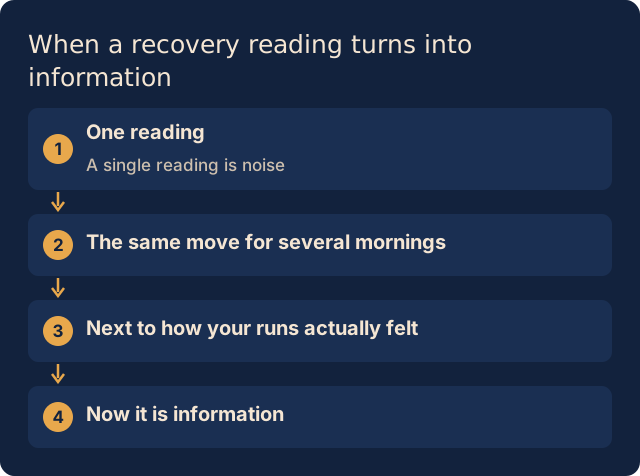
Recovery signals are the morning and in-run measurements, such as resting heart rate, heart rate variability and cardiac drift, that show how a runner's body is absorbing training. A single reading is noise. A reading that moves the same way for several mornings, next to how your runs actually felt, is information. These questions cover what each signal measures and where it stops being useful.
-
Should I run with low HRV?
How to read a low HRV morning against your baseline, sleep and recent load, when a dip is worth easing off for, and what HRV can't tell you.
-
What does a rising resting heart rate mean?
What raises resting heart rate, why one high morning means little, when a trend held over several days matters, and how to weigh it against your week.
-
Why does heart rate drift upward on runs?
Why heart rate climbs on steady runs while pace holds: the sweat and heat mechanism, what makes drift steeper, and when drift is worth a second look.
-
What Does a Readiness Score Actually Measure?
What a readiness score is built from, why it swings night to night, what it can't see about your training, and how to weigh it against your legs.
-
Is Running by Feel Better Than Heart Rate?
What heart rate and perceived effort each measure on a run, where each one gets fooled, and how to read them against each other instead of picking one.
-
Zone 2 training: the signal vs the dogma
What easy aerobic running does, where the 80/20 ratio, heart-rate formulas and never-leave-zone-2 rules overreach, and how to check them against your data.
-
What is a normal heart rate when running?
What a normal running heart rate is, why 220 minus your age often gets it wrong, and how to test your own maximum heart rate.
-
How long does recovery after running take?
How long recovery takes after 15 km or a long run, what heart rate recovery and resting heart rate tell you, and when to resume intervals.
-
How do you set up a Garmin vivoactive 4 watch for running?
Running with a Garmin watch: data screens, heart rate zones, alerts, workouts and battery on the vivoactive 4, checked against the owner's manual.
-
Can You Trust Your Watch's VO2Max Estimate?
This article walks through how a watch builds its VO2Max number, why two watches can disagree, and what to check in your own training data instead.