Easy running and effort
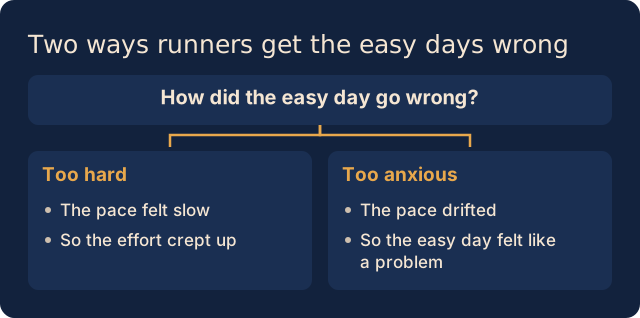
Easy running is the low-intensity running that makes up most of an endurance runner's week, done at an effort you could hold a conversation at. Most runners get the easy days wrong in one of two directions: too hard because the pace feels slow, or anxious because the pace drifted. These questions cover what effort, pace and heart rate each tell you on an easy day.
-
Are my easy runs actually easy?
A no-lab test for whether your easy runs are easy: the talk test, what heart rate adds, why easy days drift too hard, and what to check in your own runs.
-
Should I run easy when I feel great?
Why an easy day stays easy when you feel great, what feeling fresh does and doesn't measure, and what to check before running a little faster.
-
Why does easy pace feel harder some weeks?
Why the same easy effort gives a slower pace some weeks: heat, sleep, dehydration and training load, and how to tell a bad week from a real slowdown.
-
Why do legs feel dead after easy runs?
What delayed onset muscle soreness is, why a slow pace doesn't decide how sore your legs get, and the signs that point past ordinary soreness.
-
Why does the same pace feel harder in the heat?
Why a familiar pace feels harder in the heat: where your blood goes, what sweat costs, how heat acclimation helps, and how to compare hot and cool runs.
-
Does cadence actually matter for a recreational runner?
What cadence changes in your stride, why the popular 170 to 180 range is not a rule for you, and what to check in your own running data instead.
-
Should my long runs be at race pace?
What a long run builds, why running it at goal race pace costs more than it gives, and when a race-pace finish belongs in your long run.