Are my easy runs actually easy?
Your easy runs are easy if you can talk in full sentences without gasping. Easy running is running at an effort low enough to build aerobic fitness while you recover from harder days. If you only get a few words out per breath, the run is too hard, and most self-coached runners drift into that moderate grey zone.
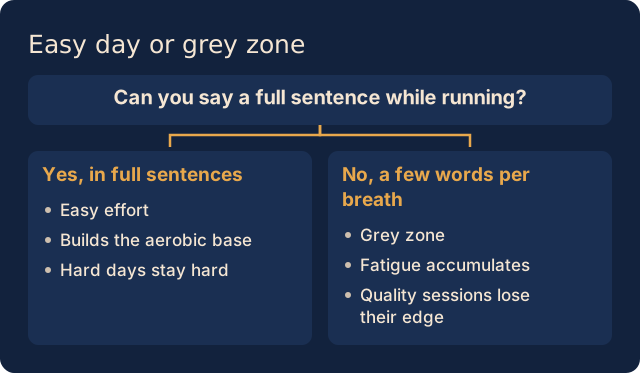
How do I check without a lab or a gadget?
The talk test is the check: say a full sentence out loud while running. A sentence that comes out smoothly means you're at an easy effort. A sentence that comes out clipped, a few words, a breath, a few more, means you're working harder than easy. Some runners prefer the nose-breathing version of the same test: comfortable breathing through your nose means easy, and needing your mouth to keep up means you've stepped up an intensity.
Both versions get you to the same answer without staring at a watch. Both also work on any route, in any weather and on any day, which a fixed pace target never does.
What heart rate should an easy run be?
Easy heart rate sits around 70% of max heart rate as a common rough guide, or comfortably under your aerobic threshold. Heart rate is a useful cross-check, not a master. Treat the number loosely: heart rate drifts with heat, dehydration, caffeine, sleep and stress, so a reading that looks too high on a hot, tired day may just be the day. The conversational effort is the more honest signal from one day to the next.
Max heart rate estimates add error to the heart rate guide. Age-based formulas miss plenty of runners by a wide margin, so a percentage of an estimated max can put the easy ceiling in the wrong place before the run starts. A ceiling taken from where your own talk test breaks down is a better anchor than a formula.
Why easy has to be properly easy
Easy running does two jobs: building the aerobic base that underpins everything else, and letting you recover enough that your hard sessions can be genuinely hard. Run easy days too fast and that structure collapses. Every run drifts to moderate, fatigue accumulates, your quality sessions lose their edge, and you plateau while feeling vaguely tired all the time. The slowness isn't a compromise. The slowness is the mechanism.
The grey zone is the moderate effort between easy and hard: too fast to recover from quickly, too slow to train what a hard session trains. A week of grey-zone runs feels productive because every run feels like work. The cost shows up later, in an interval session that falls flat because your legs never got a real easy day.
Why does truly easy pace feel so slow?
Truly easy pace feels slow because you judge pace by the clock, while your aerobic system responds to effort. The pace feels almost embarrassingly slow at first, especially if you're fit enough to push. The discomfort is ego, not physiology. Give it two or three weeks and two things usually happen: the pace stops feeling so slow as your aerobic system adapts, and your hard days feel noticeably better because you're recovered for them.
You don't have to take anyone's word about easy pace. One way to find out is to cap a fortnight of easy runs at conversational effort and judge the hard sessions yourself.
What to check in your own runs
Your own run history answers the question better than any rule. Take the runs from the last couple of weeks that were meant to be easy and look at heart rate across each one, not only the average. When those runs sit in the same heart rate range as your steady efforts, the line between easy and moderate has blurred. When easy-day heart rate stays well below your harder sessions and the hard sessions went well, your easy days are doing their job.
A worked example in general terms: an easy pace set from an old race result, held on every easy day. On cool, flat days the talk test passes at that pace. On a hilly route or a warm afternoon, the same pace pushes breathing into short phrases and heart rate up toward threshold. The pace never changed; the effort did. Holding effort instead of pace on those days means running slower, and the slower run is still the easy run.
The talk test has limits too. Group runs pull easy pace toward the fastest runner, and chatting in a group hides how hard breathing actually is. Steep climbs raise effort at any pace, so a walk break on a hill can still be part of an easy run. Heat, altitude and illness all push heart rate and breathing up at the same pace, which is a reason to slow down, not a sign the test failed.
Sources
- What is best practice for training intensity and duration distribution in endurance athletes?. Seiler, 2010, Int J Sports Physiol Perform.
- How do endurance runners actually train? Relationship with competition performance. Esteve-Lanao et al., 2005, Med Sci Sports Exerc.
- Heart rate monitoring: applications and limitations. Achten et al., 2003, Sports Med.
Still not sure your easy is easy?
- How do I know if my easy runs are easy enough?
- Use the talk test: full sentences without gasping means easy. A few words at a time means too hard. Breathing comfortably through your nose is another good sign.
- What heart rate should easy runs be?
- Around 70% of max heart rate, or comfortably below your aerobic threshold, works as a rough guide. The talk test is more reliable than any single number, because heart rate moves with heat, sleep and stress.
- Why are easy runs supposed to feel slow?
- Easy runs build aerobic base and protect recovery so hard days can be hard. Run them too fast and every run blurs into moderate, and both ends of your training suffer.
Tempo checks your easy days against your own data
Tempo can show you what your "easy" runs are really costing in heart rate and load, then leaves the decision about what to change with you.
Start free: 14 days, no card