Why do legs feel dead after easy runs?
Delayed onset muscle soreness is the most common reason legs feel dead the day after an easy run: the ache that follows small-scale muscle damage from eccentric loading, peaking around 24 to 48 hours later. The run doesn't need to be hard. Pace rarely decides that load; surface, slope and the week behind the run decide more.
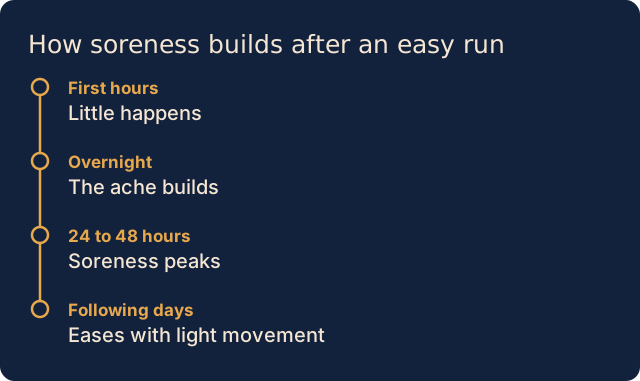
What delayed soreness actually is
Delayed onset muscle soreness, or DOMS, is the by-product of eccentric loading. Every time a foot lands, the quadriceps and calf muscles don't just contract, they lengthen while still under tension to absorb the impact. Lengthening under load is what creates microscopic disruption inside the muscle fibers, far short of an injury, but enough to trigger a local inflammatory response and a small shift of fluid into the tissue around the fibers.
The inflammatory response is what the next day's heaviness actually is. Fluid pooling around the damaged fibers stiffens the tissue, and the fascia around the muscle grows more sensitive to pressure, which is why legs that felt normal on the run feel dead on the stairs the next morning. The timeline matches that process closely: little happens in the first few hours, the ache builds overnight, and it peaks around 24 to 48 hours before easing over the following days.
Why doesn't a slow pace protect my legs?
A slow pace doesn't protect your legs because pace is a cardiovascular target, not a mechanical one. Running slowly keeps heart rate and breathing easy, but says nothing about how much eccentric load each footstrike puts through the quads and calves. A downhill stretch, a cambered trail, worn shoes, or simply running a new route changes how the legs absorb each landing, and any of those can add more muscular load than running faster on flat, familiar ground.
The week behind the run matters as much as the run itself. A harder session a day or so earlier, a short night of sleep, or a day of under-fueling all leave the muscle fibers partway through repair before the next run even starts. An easy run layered on top of that unfinished repair can tip into the same soreness as a genuinely hard one, even though the effort on the watch looked identical to any other easy day.
What makes it worse, and what speeds recovery
Sleep is where most of the muscle repair happens, so a short night slows repair down and stretches the soreness out over more days than a full night would. Being under-fueled or dehydrated has a similar effect: less protein available to rebuild the damaged fibers, and more concentrated inflammatory byproducts sitting in less fluid volume, both of which make the same soreness read as worse.
Light movement helps more than rest does, within reason. An easy walk or an easy second run increases blood flow through the sore tissue and eases the heaviness faster than sitting still all day. Stacking a genuinely hard session on top of unresolved soreness does the opposite: it adds fresh damage before the first round has finished repairing, which is how dead legs turn into a longer slide instead of a one-day dip.
Is it soreness, or something else?
Ordinary soreness is symmetric: both legs, general muscle bellies rather than one pinpoint spot, and ordinary soreness eases over the following days with light movement instead of building further. A pattern that breaks from that is worth a closer look: soreness on one side only, a tender spot that sits over a joint or tendon instead of the muscle itself, swelling, or heaviness that keeps compounding across several consecutive easy days instead of fading.
A single morning of dead legs is a weak signal either way. The more honest read sits in the pattern across recent runs: how load and recovery have tracked over recent weeks, laid out with the data behind it instead of a feeling. Tempo lays that pattern out with the runs it came from, so a runner can check it against how the legs actually feel and push back on any part of it before deciding whether to run easy, back off, or carry on as planned.
What to check in your own runs
The easy run itself and the days around the run hold most of the explanation for dead legs. Look at the elevation profile first: a route with long descents puts more eccentric load through the quads than its pace suggests. Then look at what changed: new shoes, a new surface, a longer run than usual, a hard session a day or so before. Last, watch the following days. Soreness that eases from one day to the next fits ordinary DOMS; soreness that stays the same or grows across several days fits something else.
A worked example in general terms: an easy run on a hilly loop at the usual pace, followed by stiff quads on the stairs the next morning. The pace was easy; the descents were not. The same effort on a flat route the following week leaves the legs fine. A comparison like that, same effort on different terrain, tells you more than any single sore morning.
Sources
- Exercise-induced muscle damage in humans. Clarkson et al., 2002, Am J Phys Med Rehabil.
- Recovery and Performance in Sport: Consensus Statement. Kellmann et al., 2018, Int J Sports Physiol Perform.
- A framework for the etiology of running-related injuries. Bertelsen et al., 2017, Scand J Med Sci Sports.
Is this soreness normal?
- Why do legs feel dead after easy runs?
- Delayed onset muscle soreness, not the pace, is almost always the cause. Every footstrike asks the quads and calves to lengthen under load, which creates small-scale damage in the muscle fibers. The inflammatory response to that damage peaks around 24 to 48 hours later, long after the run itself felt easy.
- Is DOMS normal after an easy run?
- Yes, in the sense that DOMS isn't a sign that something went wrong. Pace controls cardiovascular effort, not the mechanical load on a muscle from each footstrike, so a slow run on a downhill route, an uneven trail, or new shoes can load the tissue as much as a harder session on flat, familiar ground.
- When should dead legs be a bigger concern than usual soreness?
- When the soreness sits on one side only, centers on a specific spot over a joint or tendon rather than the whole muscle, or keeps building across several consecutive easy days instead of easing. Ordinary soreness fades with light movement; a pattern that doesn't ease that way is worth a closer look at the data, not pushing through on feel alone.
Tempo shows the load behind the soreness
Tempo lays out how recent runs have stacked up, pace, surface, and recovery, with the data behind each point, so a runner can weigh today's heaviness against their own pattern and disagree with any part of it before deciding what's next.
Start free: 14 days, no card