Why does the same pace feel harder in the heat?
The same pace feels harder in the heat because your heart has to supply blood to working muscle and to your skin for cooling at the same time. Heat doesn't change your pace; heat changes what that pace costs. Cardiac drift is the result: heart rate climbs through a run while pace holds steady.
Where does the blood actually go?
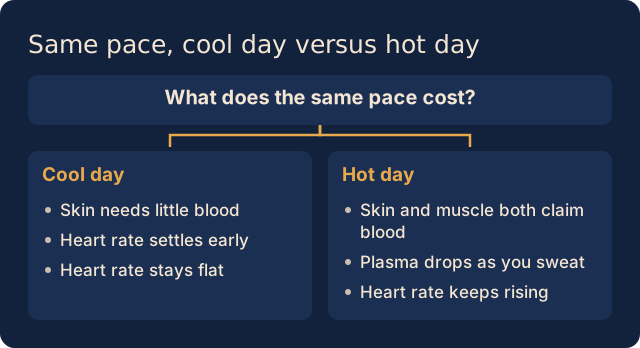
Blood goes to working muscle and to skin at the same time on a hot run. Your circulatory system moves a limited amount of blood at any moment, and heat adds another claim on it. Working muscles need oxygen and fuel delivered at whatever rate the pace demands. Skin needs blood pushed toward the surface too, so sweat can evaporate and carry heat away. Neither claim goes away because the other exists.
On a cool day, working muscles get most of the blood the legs need, because skin barely needs any. On a hot day, the skin's share climbs as your core temperature rises, and muscles stay supplied only if your heart pumps faster and pushes more total volume through the system. The pace on your watch stays flat. The heart rate underneath it does not.
The gap between pace and heart rate
Exercise physiologists call the pace and heart rate gap decoupling: pace stays constant while heart rate climbs to cover the added cooling load. A run that feels perfectly matched to effort in cool weather can show a heart rate drifting upward across the whole distance in heat, even on flat ground, even at a pace that used to feel conversational.
Pace-to-heart-rate drift shows up after the run as well, not only in the moment. The raw file behind a run carries pace next to heart rate for the whole route, and reading them side by side shows exactly where pace and heart rate stopped matching, without a formula smoothing over the gap.
What does sweat cost you?
Sweat costs you blood plasma, and your legs end up paying the bill. Sweating is the cooling mechanism working as intended, but fluid lost as sweat comes largely from blood plasma, so as a hot run goes on, the volume of blood available to move drops. A heart working with less fluid to pump has to beat faster just to maintain the same output, stacking on top of the extra demand skin cooling already created.
Humidity raises the price further. Sweat cools you only when it evaporates, and in humid air less of it does, so the body keeps sweating and keeps losing fluid for a smaller cooling return. A warm, humid day can ask more of your heart than a hotter, drier one.
Does the heat get easier with time?
Yes, heat acclimation blunts the cost over repeated exposure. Heat acclimation is the set of changes that follow regular training in the heat: sweat rate improves, plasma volume expands to buffer the loss, and the same conditions ask less of your heart than they did early on. Most of that builds over a couple of weeks of regular hot sessions and fades again when the exposure stops.
None of that happens on a single run, which is part of why the first hot session of a season feels disproportionately brutal compared to where fitness actually sits. A hot spell in an otherwise cool spring hits harder than the same temperature in late summer, for the same reason.
What the honest pacing call looks like
Pace is a measurement of distance over time, nothing more. Pace was never a measurement of effort, and heat is where that distinction stops being academic. A target pace chosen in cool weather carries an assumption about what your heart rate was doing at that pace, and heat breaks the assumption without changing the number.
Running by heart rate or perceived effort instead of pace on a hot day isn't a concession. Effort-based running reads the signal that reflects what your body is doing right now, not a number calibrated under different conditions. Slower on paper and matched in effort is the same session; faster on paper and overreaching the cooling system is a different one entirely, however identical the splits look.
A worked example in general terms: the same easy route run on a cool morning and on a hot afternoon, at the same pace. On the cool morning, heart rate settles early and stays flat. On the hot afternoon, heart rate starts a little higher and keeps rising through the second half. Comparing the second halves of both runs shows how much the heat added, and how much slower the hot run would have needed to be to match the cool one in effort.
Some edge cases sit outside the usual pattern. A warm treadmill room with no airflow can raise heart rate the way outdoor heat does. A run the day after a hot run, with fluids not yet replaced, can start with less plasma volume before the temperature is even a factor. In both cases, heart rate and effort tell you more than the pace on the screen.
Sources
- Cardiovascular drift during prolonged exercise: new perspectives. Coyle et al., 2001, Exerc Sport Sci Rev.
- Adaptations and mechanisms of human heat acclimation: Applications for competitive athletes and sports. Périard et al., 2015, Scand J Med Sci Sports.
- Consensus recommendations on training and competing in the heat. Racinais et al., 2015, Br J Sports Med.
Pace or heart rate on hot days?
- Why does the same pace feel harder in the heat?
- Holding that pace in heat means your heart is doing more work underneath it. Blood gets split between your working muscles and your skin's cooling effort, so the same speed now asks for a higher heart rate and a harder feeling, even though the number on the watch hasn't moved.
- Does heat always slow you down, even on an easy run?
- Heat raises the cost of any effort, not just hard sessions. An easy run in high heat can produce the same heart rate as a moderate run in cool weather, because the cooling demand on your circulation doesn't care what pace you picked.
- Should I just run by heart rate instead of pace when it's hot?
- Heart rate and perceived effort are the more honest read in heat, since pace alone hides how hard your body is actually working. Weigh that reading against your sleep, hydration and the rest of your week rather than following it as a strict rule.
Tempo reads the drift, not just the pace
Tempo can pull cadence, ground contact, vertical ratio and pace drift straight from the raw file behind a hot, hard run, so you can see exactly where effort and pace parted ways, and weigh what that means for your next session yourself.
Start free: 14 days, no card