What is a normal heart rate when running?
Your running heart rate shows how hard your body is working right now. An easy run usually sits somewhere between 60 and 75% of your maximum heart rate. You'll estimate that maximum better with a field test than with the formula 220 minus your age, which can be well off for any one person.
What is a normal heart rate when running?
No single number is normal for everyone: your running heart rate depends on your maximum heart rate, your fitness and the type of session. An easy run at 130 beats per minute can be relaxed for one runner and hard work for another. What does hold steady is the ratio between your heart rate and your maximum heart rate (HRmax).
Normal heart rate by effort level
As a guide, expressed as a percentage of your maximum heart rate:
| Effort level | % of HRmax | How it feels |
|---|---|---|
| Recovery run | 60-70% | Talking comes easily |
| Steady run | 70-80% | Talking in short sentences |
| Tempo intervals | 85-92% | A few words per breath |
| Intervals up to race pace | 92-100% | Talking is impossible |
How do you work out your maximum heart rate for running?
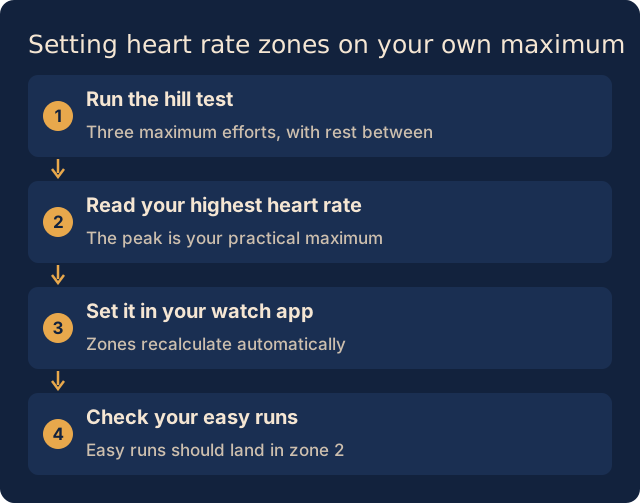
The most reliable estimate comes from a field test, not a formula. Find a steep hill or stairs that take 3 to 4 minutes, run them three times at maximum effort with 2 to 3 minutes of rest in between, and read your highest heart rate on the last attempt from your watch data. That peak is your practical maximum heart rate.
Why 220 minus your age often gets it wrong
Tanaka, Monahan and Seals pooled 351 studies with more than eighteen thousand participants. Their conclusion: 220 minus your age underestimates maximum heart rate more and more as you get older, and 208 minus 70 percent of your age fits better. More important still is the spread of roughly 10 to 12 beats per person. If you're 35, the formula gives 185, but your real maximum could just as easily be 175 or 195. Train on zones built from that, and you run consistently too hard or too easy, and an easy run sometimes feels harder than it should, see why easy pace feels harder some weeks.
Field test: estimating your own maximum heart rate
Pick a day with fresh legs, warm up for 15 minutes and do the hill test above. Watch for two things. A wrist sensor lags at peak effort, so a chest strap gives more accurate values. And your maximum heart rate drops with age but doesn't change week to week; testing once a year is enough.
Higher heart rate at the same pace after the test? Fatigue or heat is usually involved, not your fitness: why the same pace feels harder in the heat.
Worked example: finding your maximum heart rate in practice
Say you're 32 and the formula says 188. Your hill test reads 197. Use 197. Your steady zone, around 70 to 75%, then sits at 138 to 148 beats instead of the 132 to 141 the formula gave you. That gap of about 6 beats decides whether your easy run is easy enough to recover from, or whether you run slightly too hard every week and build fatigue without noticing.
Do men and women have different running heart rates?
Yes, but the difference is mostly in the absolute values, not in how heart rate behaves. Women have, on average, a higher resting heart rate and a slightly smaller stroke volume, the blood the heart pumps per beat, so they often see a higher heart rate at the same speed. The menstrual cycle also affects resting heart rate and recovery; a rising resting heart rate can point to incomplete recovery, see what a rising resting heart rate means.
The spread between individuals is larger than the average gap between men and women: two runners of the same age at the same pace can differ by 10 beats. So compare your heart rate only with your own history.
What is a good heart rate for an easy run?
An easy run belongs in zone 2: roughly 60 to 70% of your maximum heart rate. With a maximum of 190 that's about 114 to 133 beats per minute. You should still be able to talk comfortably in full sentences. If you can't, you're running too hard, however slow your pace feels.
When your heart rate on easy runs sits above the table
Is your heart rate on easy runs consistently 10 to 15 beats higher than zone 2 predicts? That's no reason to panic. Heat, short sleep, stress and dehydration push heart rate up without your pace changing. On longer runs, heart rate drift adds to that: why heart rate drifts upward on runs.
So compare easy runs under similar conditions: same route, same time of day, similar weather. That shows you whether your heart rate at easy pace is dropping over the weeks, which says more about building fitness than any single session.
What should my average heart rate be on a run?
No number is right for everyone. Someone with a maximum of 195 averaging 150 is at a very different intensity from someone with a maximum of 175. An average of 145 could be an easy run on a cool evening, or a hard tempo block on a hot day after a bad night.
Keep your own reference per session type instead: your easy runs, your intervals, your long runs. If your average on an easy run this week is 8 beats higher than usual for that type, the gap tells you more than the absolute number. That way you build a personal norm instead of borrowing a table from the internet.
Why is my heart rate so high when I run?
The most common cause is simple: you're running faster than your fitness allows right now. Heat and humidity matter a lot too; above 15 to 20 degrees Celsius, your heart rate at the same pace can come out 5 to 15 beats higher. Caffeine, stress, poor sleep and a big meal shortly before the run also push it up. And during intervals, a wrist sensor can lock onto your cadence instead of your heart rate.
Sometimes a high heart rate says something about your training load rather than that one run. If your easy run this week sits 10 beats higher than three weeks ago, the rise is a classic sign of incomplete recovery, building fatigue or an infection coming on. After illness your race goal also deserves a fresh look, see what happens to your race goal after illness.
When is a high heart rate while running a cause for concern?
Usually a high heart rate is no cause for concern, because a high heart rate on a run comes with the work you're doing and mostly reflects intensity, temperature, sleep and stress. The number on its own is not a diagnosis.
Do see a doctor if a high heart rate comes with chest pain or pressure, dizziness or fainting, if your heartbeat feels irregular or won't come down after rest, or if the heart suddenly races for no reason. A resting heart rate that climbs for weeks while your load stays the same is also a reason to back off. If it's mainly the numbers you doubt: wrist sensors differ substantially from an ECG reference during exercise (Gillinov et al., 2017), and a chest strap is more reliable.
How do you use heart rate zones without clinging to a generic plan?
Heart rate zones only help once the zones are set on your real maximum. In the Garmin, Polar and Coros apps you set your watch's maximum heart rate manually in your profile settings, and the zones recalculate automatically. Then check that your easy run lands in zone 2 and your interval block in zone 4. If it doesn't, adjust based on your own sessions rather than the default percentages. On a vivoactive 4 watch, here is the full setup.
Sources
- Age-predicted maximal heart rate revisited. Tanaka, Monahan and Seals, 2001, J Am Coll Cardiol.
- Variable Accuracy of Wearable Heart Rate Monitors during Aerobic Exercise. Gillinov et al., 2017, Med Sci Sports Exerc.
- Cardiovascular drift during prolonged exercise: new perspectives. Coyle and González-Alonso, 2001, Exerc Sport Sci Rev.
Still unsure about your numbers?
- Is a heart rate of 180 while running dangerous?
- Usually not. With a maximum of 195, 180 is simply a hard interval. Without chest pain, dizziness or a heart rate that won't come down after rest, a high number is no cause for concern.
- Why is my heart rate higher than my running partner's at the same pace?
- Because your maximum heart rate and stroke volume differ, even at the same age and speed. It says nothing about fitness; compare only against your own history.
- Can training change my maximum heart rate?
- Barely. It declines gradually with age. What does change is your resting heart rate and how quickly your heart rate recovers after effort: that is where your build shows.
- How reliable is my watch's heart rate reading?
- Reasonable on easy runs, but during intervals and peak efforts a wrist sensor regularly misses. For accurate zones, a chest strap is better.
- Should I train by heart rate or by pace for a race?
- Train by pace and feel, with heart rate as a check afterwards. On easy runs heart rate is genuinely useful: it keeps you honest when your pace creeps up.
Tempo puts your heart rate next to the rest of your training
Every read on your heart rate comes with the pace, duration and conditions it was measured against, so you decide what it means for your next run.
Start free: 14 days, no card