Should I run with low HRV?
A lone low HRV reading is not a reason to skip your run. HRV, or heart rate variability, is the variation in time between heartbeats, and any stress lowers it, not only training. A small dip with good sleep and fresh legs points to running as planned; a big dip with bad sleep and heavy legs favours an easy day.
What is HRV actually measuring?
HRV measures how much the gap between your heartbeats changes from one beat to the next. Higher variability generally signals that your parasympathetic ("rest and recover") system is in charge. Lower variability means your body is under load, and that load can come from anywhere. Poor sleep, a glass of wine, a stressful day, the start of a cold, dehydration, travel, or a hard session yesterday will all push the number down. HRV reflects total stress on your nervous system, not your training alone.
Is one low morning enough to change the plan?
One low HRV morning is rarely enough to change the plan, because a single reading is noisy. Your own rolling baseline, and how far today sits outside your normal day-to-day swing, tells you far more than an absolute figure. A dip within your usual variation is mostly noise. A dip well outside it, holding low across several days, is the signal worth weighing. Reacting to single mornings means chasing ghosts.
When does a low reading deserve respect?
A low HRV reading deserves more weight when other signals join the dip: short or broken sleep, legs that feel heavy, a resting heart rate that is also up, or a few hard days already in the bank. When several of those line up, your body is reporting the same thing from more than one direction. A hard session on that kind of day buys less adaptation and carries more risk.
Signs the run can go ahead
A single low number with good sleep, fresh legs and a normal resting heart rate is often noise, or yesterday's session still clearing. Plenty of strong workouts happen on a slightly low HRV morning. One middle path is to start the session and let the first few kilometres vote. If you warm up and feel strong, carry on. If the effort feels out of proportion early, you have your answer and can switch to something easier.
The same reading on different mornings
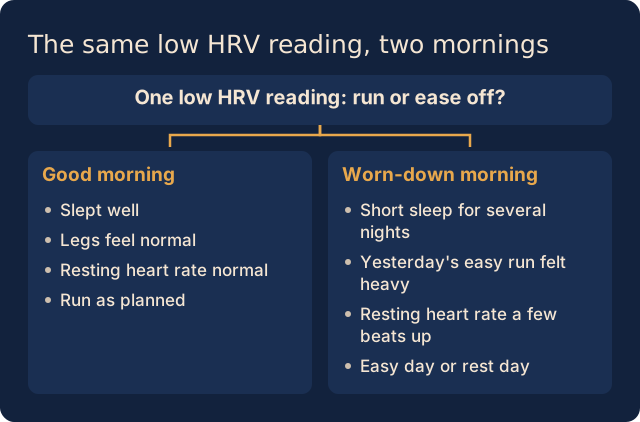
Take one low HRV reading and set the number against a good morning. You slept well, your legs feel normal, your resting heart rate sits where it always sits, and yesterday was a hard interval session. The dip reads as yesterday's work still clearing, and the case for running as planned is strong.
Now put the identical reading on a worn-down morning. Sleep has been short for several nights, a work deadline is eating your evenings, yesterday's easy run felt heavy, and your resting heart rate is a few beats up. The HRV number has not changed, but the picture around it has. The worn-down morning makes a far stronger case for an easy day or a rest day.
What to check in your own data
Your normal range is the first thing worth knowing. Several weeks of morning readings show how much the number moves on ordinary days. A dip inside that range is noise you already live with. A dip below it, repeated, is new information.
Measurement habits matter just as much as the number. A reading taken at a different time, in a different position, or on a different device is not comparable with your usual one, so a sudden drop after a change in routine says more about the routine than about you. Overnight averages and morning spot checks are separate measures, so compare each with its own history.
HRV and resting heart rate read better together than apart. When HRV falls and resting heart rate rises over the same few days, both are pointing the same way. When only one of them moves, the case for changing anything is weaker.
What HRV can't tell you
Heart rate variability is a useful lagging indicator, not an oracle. Measured inconsistently, the number gets noisier still. HRV can't tell a hard week of training from a hard week at work, and it can't tell you whether today's session matters for your goal. A dip that arrives with a sore throat or a temperature makes the HRV number the least important part of the picture.
Your baseline also moves with your training. A heavier block, a taper, or a return after a break can shift your normal range, so a comparison window that reaches back across one of those changes will misread today. The question is always how today compares with your recent normal, not with last season.
HRV works best as one voice in the conversation, alongside your own read of your body, which no number can replace.
Sources
- Training adaptation and heart rate variability in elite endurance athletes: opening the door to effective monitoring. Plews et al., 2013, Sports Med.
- Endurance training guided individually by daily heart rate variability measurements. Kiviniemi et al., 2007, Eur J Appl Physiol.
- Monitoring training status with HR measures: do all roads lead to Rome?. Buchheit, 2014, Front Physiol.
Still unsure about today's run?
- Should I run with low HRV?
- Not automatically rest. Weigh the reading against your sleep, how you feel, and your recent load. A small dip with good feel points to running, perhaps starting conservatively. A big dip with poor sleep and heavy fatigue is a stronger case to go easy.
- What counts as a meaningful HRV drop?
- A drop well outside your own rolling baseline, especially one that holds across several days. Inside your normal day-to-day variation, a low reading is noise.
- Does low HRV always mean overtraining?
- No. Sleep, alcohol, illness, stress, dehydration and travel all lower HRV. The number reflects total load on your body, not training alone.
Tempo reads your HRV in context — with you
Tempo already knows your baseline, your sleep, and your week — so instead of a number, you get the trade-off laid out, and the call stays yours.
Start free: 14 days, no card