What Does a Readiness Score Actually Measure?
A readiness score is a composite number, built from overnight heart rate variability, resting heart rate, and sleep duration and quality, that estimates how recovered your body looks today. The score does not know your race goal, your training plan, or why last night went badly. The number is one data point. The decision stays yours.
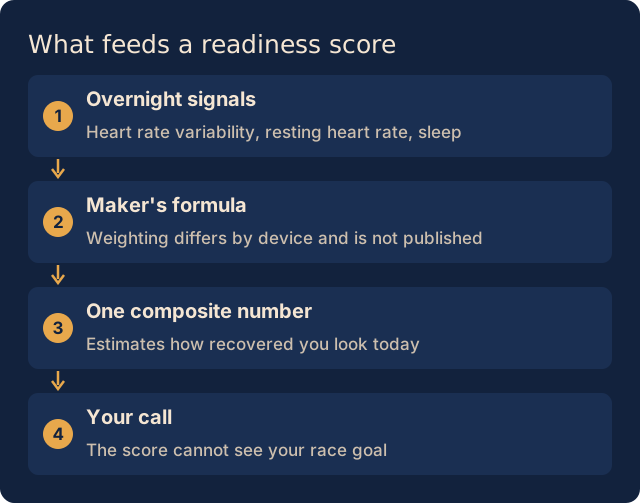
What goes into a readiness score?
A readiness score pulls from a small set of overnight signals: heart rate variability, resting heart rate, and how long and how well you slept. Heart rate variability measures how much the time between heartbeats varies from one beat to the next; more variation generally reflects a nervous system under less strain. Resting heart rate is how slow your heart sits at rest, a related but separate reading. Sleep duration and quality add context from a device worn through the night, not from how the day actually felt.
Some scores fold in recent training load as well, weighing yesterday's hard session or a stretch of short nights. The formula differs by maker, and none of them publish the exact weighting, so different devices reading the same night can land on different numbers for the same person. A new device, a looser strap or a software update can move the score with nothing changed in you, so a step change on the day of a switch belongs to the device.
Why does the score jump around?
The score jumps around because heart rate variability moves for reasons that have nothing to do with training. Alcohol, a late meal, travel across time zones, the start of a cold, and ordinary day-to-day variation all push the number around before training enters the picture. A single low reading is common and rarely means much on its own.
Training load leaves a mark on the readiness score on top of that noise: a hard session suppresses the next morning's reading, and the suppression lingers before it clears. Watching the trend across several weeks makes the lag visible, with a dip right after a tough effort and a recovery as the easy days accumulate. A low score that lines up with a known hard effort reads differently from a dip with no hard training behind it at all.
Sleep tracking carries a separate error. A device inferring sleep stages from movement and heart rate will misjudge a restless but light sleeper, or read ordinary movement as waking. A noisy night of tracking can read as a bad recovery night even when neither is true, and the score has no way to flag the difference.
What the score can't see
A readiness score has no access to your race goal, the phase of your training block, or how a session felt once you were a few minutes into the session. A middling score looks the same whether you are tapering for a race in a few weeks or building a new base, and the sensible response to each is different.
The number also can't tell physiological fatigue from ordinary life stress. A stressful work stretch and a genuinely overtrained body can both depress heart rate variability, and the device cannot tell you which one you're in. You, and the pattern across your own weeks, can make that distinction.
One low score, read in context
Picture a low score on the morning after a long-haul flight. Sleep was short and broken, resting heart rate is up, and heart rate variability is down, so every input agrees. The cause is the travel, not your training, and the score has no field for that. Any easing that day is about the trip, and the next few mornings show whether the dip clears.
Now picture the same low score on an ordinary morning at the end of a heavy training week, after several nights of solid sleep. Nothing outside training explains it, the dip has company in heavy legs, and the low reading has held for days. The number is the same; the case for backing off is much stronger.
How much should a low score count?
A low score counts for more as a trend than as a verdict. Watching it drift against your own baseline over several weeks tells you more than any single morning does. A number that has been low alongside poor sleep and heavy legs for days running is worth respecting. A dip after one long travel day or a late night is noise.
Your own notes sharpen the score. A quick line each morning on sleep, soreness and mood gives you something to hold the number against, and self-reported measures of that kind hold up well against device readings. When the score and your notes disagree, the gap is the interesting part.
The call on whether to push the session or back off stays a judgment only you can make, informed by how your legs feel once you're moving.
Sources
- Monitoring Athletic Training Status Through Autonomic Heart Rate Regulation: A Systematic Review and Meta-Analysis. Bellenger et al., 2016, Sports Med.
- Monitoring the athlete training response: subjective self-reported measures trump commonly used objective measures: a systematic review. Saw et al., 2016, Br J Sports Med.
- Sleep and athletic performance: the effects of sleep loss on exercise performance, and physiological and cognitive responses to exercise. Fullagar et al., 2015, Sports Med.
Low score this morning?
- What does a readiness score actually measure?
- Most scores combine overnight heart rate variability, resting heart rate, and sleep duration and quality into one estimate of how recovered your body looks this morning. The number says nothing about your race goal, your training plan, or how the day will feel once you start moving.
- Why does my readiness score change so much from day to day?
- Heart rate variability and sleep tracking both carry real noise: alcohol, travel, a late meal, a restless but otherwise fine night, or ordinary day-to-day variation can all move the number before training even enters the picture. A single low reading is common and rarely means much by itself.
- Should I skip a run because of a low readiness score?
- Not automatically. A low reading carries more weight when your legs feel heavy too, sleep over recent nights has been poor, and the dip has repeated for days rather than showing up once. A single low morning after travel or a late night is usually noise; a dip holding across days alongside poor sleep is the stronger signal to go easier.
Tempo shows the data behind every call
Instead of a single opaque number, you see the heart rate variability, sleep, and training load behind today's read, line by line, so you can push back on any part of it before you decide what to do with your legs.
Start free: 14 days, no card