How long does recovery after running take?
Recovery after running is measurable. You're ready for normal training when your heart rate drops clearly within 60 seconds of stopping, your resting heart rate the next morning is back at your personal baseline, and your easy-run pace feels smooth again. After 15 km that usually takes 24 to 48 hours, after a long run 48 to 72 hours.
Key takeaways
- After 15 km, full recovery usually takes 24 to 48 hours; after a long run, 48 to 72 hours. Intervals come after that.
- A drop of about 12 beats in the first minute after stopping is the common guideline for heart rate recovery.
- Compare the next morning's resting heart rate with your own 30 to 60 day baseline; 3 to 5 beats higher is a normal recovery signal.
- Run recovery runs by heart rate, under 75 to 80% of your maximum, not by pace.
- Sleep, food and fluids do most of the work; cold water and compression speed things up very little.
How long does recovery after 15 km really take?
For most trained runners, full recovery after 15 km takes two to three days, with real differences by person, intensity and conditions. You often feel ready before your body is: acute fatigue fades on day one, while muscles and nervous system need longer.
Muscle fatigue versus nervous system fatigue
Muscle fatigue shows up as stiffness and a slower pace on easy runs. Nervous system fatigue shows up in the numbers first: heart rate recovery that drops more slowly and a higher resting heart rate the next morning. How fast your heart rate falls after effort reflects how quickly your parasympathetic nervous system takes back over (Cole et al., 1999).
What does heart rate recovery tell you after running?
Heart rate recovery tells you how fast your body returns to rest. The faster your heart rate drops in the first minute after stopping, the better your recovery capacity at that moment.
How to measure it: the 60-second test
Stop at the end of your run, stand still, and read your heart rate at the moment you stop and 60 seconds later. Do it after comparable runs, same duration, intensity and roughly the same weather, so your readings line up. With a chest strap on Garmin, Polar or Coros, you can read those values from your activity data afterwards.
Which drop counts as the guideline
There's no universal number. The common guideline is a drop of about 12 beats in the first minute; that cut-off comes from the research by Cole and colleagues. Your own trend matters more. Once you know your baseline on comparable runs, a deviation of 5 beats or more means something. One reading without the context of your load says little, the same lesson as whether your easy runs are too easy.
A smaller drop than usual points to fatigue: incomplete recovery, heat, dehydration or an effort that was too hard. If your resting heart rate is also up the next morning, schedule an extra rest day instead of following your plan blindly.
Resting heart rate the next morning: when is the signal normal?
Your resting heart rate only means something next to your own normal. In the data from your Garmin or Polar watch, look at your average over the last 30 to 60 days: that's your baseline. 3 to 5 beats higher on the morning after 15 km or a long run is a normal recovery signal.
One raised morning means your body is still working: run easy that day or rest completely. Two or more raised mornings in a row point to incomplete recovery; keep your training easy until the signal is back at baseline. More in what a rising resting heart rate means, and put it next to your HRV trend: should I run with low HRV?
Active recovery or complete rest after a long run?
An easy 30 to 40 minute run the next day improves blood flow and reduces stiffness, but doesn't measurably speed up muscle recovery. It does tell you whether your easy-run pace feels smooth again.
Choose complete rest if your resting heart rate is still raised, your heart rate recovery was slower than normal, or your legs feel heavy when you get up. If work or travel breaks up your week, read whether a training week can survive a work trip.
What pace belongs to a recovery run?
Run a recovery run by heart rate, not by a target pace. Stay below your aerobic threshold, roughly under 75 to 80% of your maximum heart rate. On flat ground, for most serious runners that's 60 to 90 seconds per kilometre slower than their usual easy run.
Pace is a poor guide on tired legs: after 15 km or a long run, the same pace costs more. So run by heart rate or breathing (you should still be able to talk) and ignore the pace on your watch. Muscle damage after hard efforts worsens running economy, so tired muscles burn more energy at the same pace (Assumpção et al., 2013). If your recovery run feels awkwardly slow, you're probably doing it right. Unsure mid-run whether to keep going? Read when to stop a run that's going wrong.
Which recovery method works best after running?
Sleep, food and fluids. Those three decide most of your recovery after 15 km or a long run, and no extra method makes up for a shortfall there. The first 24 hours matter most: enough carbohydrate and protein, drinking until your urine is pale, and a full night of sleep.
| Method | What it does | When it makes sense |
|---|---|---|
| Cold water (ice bath) | Reduces soreness a little, may blunt adaptation | Around a race, not in the middle of a build |
| Compression | Small effect on how sore you feel | Fine if it feels good |
| Foam rolling | Temporary comfort, doesn't directly recover you | Almost always safe |
A Cochrane review found cold-water immersion reduces muscle soreness after exercise somewhat, based on low-quality evidence (Bleakley et al., 2012).
When can you resume intervals after a 15 km race?
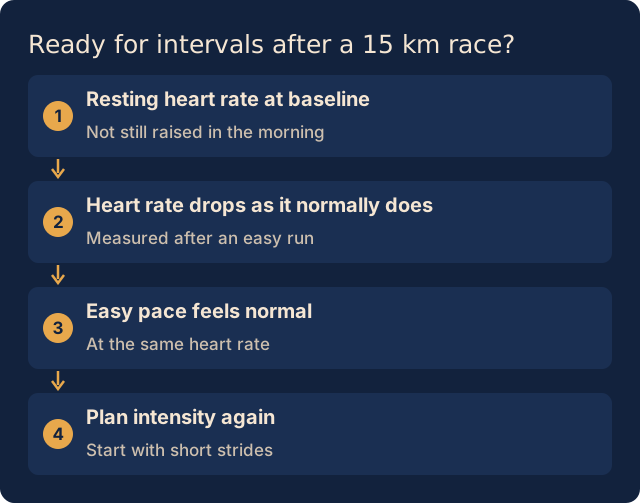
Only when three signals line up: your resting heart rate is back at baseline, your heart rate drops after an easy run as it normally does, and your easy-run pace feels normal at the same heart rate. That's usually two to four days after a 15 km race, depending on how hard you ran.
A simple schedule. Days 1 and 2: rest or a walk. Day 3: an easy 20 to 30 minute run if your resting heart rate is normal. Day 4: another easy run, and check whether your heart rate at pace matches similar runs in your history. Only when that matches two days running do you plan intensity. More on the days after a race in what to do the week after a race.
Start with 4 to 5 short strides of 15 to 20 seconds, not a full interval session. If your legs respond normally, return to your regular interval session.
Normal soreness or a problem: how do you tell the difference?
Normal soreness after 15 km sits in both legs, mostly your quads and calves, and eases every day. An injury signal sits in one place: one knee, one shin, one Achilles. If it sharpens during a run or changes your stride, stop.
Pain at night, local swelling, pain when you press one spot, or pain that grows despite rest is not normal recovery. Take several days off and have a physiotherapist look at it. See also niggle or injury?
Sources
- Heart-rate recovery immediately after exercise as a predictor of mortality. Cole et al., 1999, N Engl J Med.
- Vagally mediated heart rate recovery after exercise is accelerated in athletes but blunted in patients with chronic heart failure. Imai et al., 1994, J Am Coll Cardiol.
- Exercise-induced muscle damage and running economy in humans. Assumpção et al., 2013, ScientificWorldJournal.
- Cold-water immersion (cryotherapy) for preventing and treating muscle soreness after exercise. Bleakley et al., 2012, Cochrane Database Syst Rev.
Still unsure whether you've recovered?
- How long should I wait before running again after my first 15 km?
- At least 24 to 48 hours. Check three signals: resting heart rate back at your baseline, heart rate recovery dropping normally within 60 seconds, and an easy-run pace that feels smooth. After a first 15 km, take the long end of that range.
- Why does my heart rate come down slowly after a run even though I feel fine?
- Muscles and nervous system don't recover at the same speed. Acute fatigue is often gone within a day; your autonomic nervous system needs longer. Your feel runs ahead of your physiology. Compare the reading with your own trend on similar runs.
- Is walking a good alternative to a recovery run the day after a long run?
- Yes, especially if your resting heart rate is still raised or your legs feel heavy. Walking adds blood flow without extra load. If your resting heart rate is at baseline, an easy 30 to 40 minute run works too.
- Can training improve my heart rate recovery?
- Yes. Trained runners' heart rate drops faster after effort. Consistent aerobic training, sleep and hydration improve it gradually. Measure your drop on comparable runs to see the change.
- Should I take a week off after a 15 km race?
- Rarely. Days 1 and 2 rest or walk, day 3 an easy 20 to 30 minute run if your resting heart rate is normal, day 4 another easy run. If your heart rate at pace matches two days running, resume intensity.
Tempo puts your recovery next to the rest of your training
Your resting heart rate, heart rate recovery and easy-run pace come with the runs they belong to, so you decide when it's time to go hard again.
Start free: 14 days, no card