Can You Trust Your Watch's VO2Max Estimate?
A watch's VO2Max estimate is worth trusting as a direction, not as an exact number: track it across weeks rather than reacting to any single reading. VO2Max itself is a composite estimate of your pace and heart rate during a run, extrapolated against assumptions about your maximum heart rate and running economy, not a measured lab value.
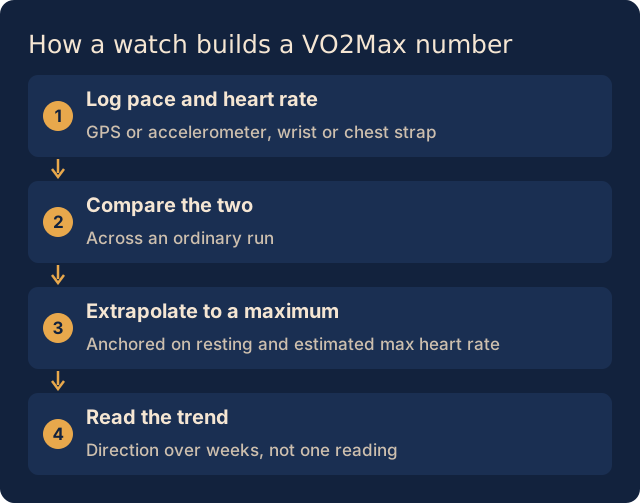
What does a watch actually measure to estimate it?
A watch estimates VO2Max from how your heart rate responds to pace during an ordinary run, not from measuring the oxygen you actually use. The sensor logs pace from GPS or an accelerometer and heart rate from the wrist or a chest strap, then an algorithm compares the two across the run. From that relationship it extrapolates toward a theoretical maximal effort you never performed, using your resting heart rate and an estimated maximum as anchors. The result is a composite guess dressed up as a clinical-sounding figure, built entirely from sub-maximal data gathered on a normal training run, not a graded exercise test with a mask and a gas analyzer.
Why do two watches give you different numbers?
Two watches can read the same runner differently because each watch guesses at inputs the sensors can't measure directly. One brand's algorithm might assume your maximum heart rate from a formula built on your age, while another nudges that assumption using your actual effort history over time. Wrist-based heart-rate sensors pick up more noise than a chest strap, especially on cold mornings, on darker skin tones, or during sharp changes of pace, and that noise feeds straight into the estimate. GPS accuracy on a trail, a track lap, or under tree cover also shifts the pace half of the equation in ways a treadmill run wouldn't. None of this means one number is right and the other wrong: they are two different guesses, built from two different sets of assumptions, about a value neither watch has actually measured.
Where the estimate tends to break down
Heart-rate sensors lose precision exactly when you most want a dependable reading: during intervals, in the cold, or on a wrist that has shifted on a bumpy trail. A comparison of wearable heart-rate monitors during aerobic exercise found their accuracy varies, and that variability becomes one of the inputs sitting underneath your VO2Max number before you ever see it. Heat and dehydration push heart rate up for a given pace through cardiovascular drift, so a long run in the sun can quietly inflate the apparent effort behind that day's data. A missed night of sleep or a lingering cold does the same thing to your heart rate without touching your actual aerobic fitness at all. None of this is a flaw unique to one brand: it is the limit of estimating a physiological ceiling from a sensor on your wrist during a normal run.
Does the trend matter more than the single number?
Yes, and by a wide margin: the direction a VO2Max estimate moves over several weeks tells you more than any single reading ever will. A number that climbs steadily alongside a block of consistent training usually reflects a real gain in aerobic fitness, because the underlying pace-to-heart-rate relationship it's built from is genuinely improving. A number that drops after a run in heavy heat, after a cold, or during a stressful week at work often reflects sensor noise or a day your body handled poorly, not a lost season of fitness. Reacting to one reading the way you might react to a race time treats a rough composite like a precise measurement, and a composite built from sub-maximal guesses was never that.
What would make the number worth trusting more
Consistency in how the data was collected matters more than which brand made the sensor. The same watch, worn the same way, on routes with similar terrain and weather, removes several sources of noise at once and leaves fitness as the main thing still moving. A chest strap during harder sessions tends to track heart rate more faithfully than a wrist sensor bouncing through intervals, which narrows one of the biggest gaps between the estimate and reality. Comparing your own pace at a given heart rate across a training block, rather than the headline VO2Max figure alone, gives you a second read on the same underlying signal. None of that makes the estimate a lab value, but it does make a change in the number mean something closer to what you'd hope it means.
What to check in your own data
Your own pace-to-heart-rate relationship across similar routes and weather is worth more than the headline number a watch hands you. A steady or improving pace at a given heart rate over several weeks is the same signal the algorithm is chasing, except you can see it directly instead of through an extrapolation layered on top. Tempo reads cadence, ground contact time, vertical ratio and pace drift directly from the activity file your watch already recorded, rather than compressing a whole run into one composite score. Comparing your splits and effort across a training block, not one isolated run, is what turns a wobbly estimate into something worth acting on, and the call on what that trend means for your training stays yours to make.
Sources
- Variable Accuracy of Wearable Heart Rate Monitors during Aerobic Exercise. Gillinov et al., 2017, Med Sci Sports Exerc.
- Age-predicted maximal heart rate revisited. Tanaka et al., 2001, J Am Coll Cardiol.
- Heart rate monitoring: applications and limitations. Achten et al., 2003, Sports Med.
Tempo reads the file behind the number
Instead of leaning on one composite score, Tempo reads cadence, ground contact, vertical ratio and pace drift straight from your raw activity file, and shows you that data so you can weigh it against the watch's own estimate yourself.
Start free: 14 days, no card