Niggle or injury? How to decide before you run
A niggle is a minor ache that eases as you warm up, leaves your stride alone and stays mild. An injury is pain that worsens as you run, changes how you move, is sharp and pinpoint, or lingers at rest. Four questions sort most cases before you run. You make the call; the questions sharpen it.
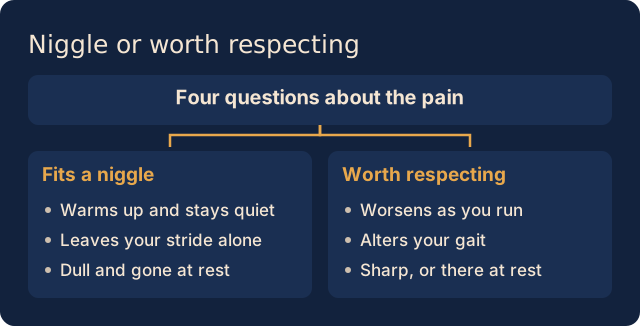
Which questions sort a niggle from an injury?
Four questions sort most cases, and each one sets a mild pattern against a worrying one.
Does the pain warm up or worsen? Many minor niggles ease within the first ten minutes and stay quiet. Pain that builds the longer you run is the opposite signal.
Does the pain change how you move? A change in movement is the big one. If pain makes you shorten your stride, land differently or limp, running on the pain isn't toughing it out: running that way teaches your body a compensation that tends to create a second problem somewhere up the chain.
Is the pain sharp or dull? Dull, diffuse, muscular aches are usually lower-stakes. Sharp, pinpoint pain, especially over a joint or bone, deserves more caution.
Is the pain there at rest? A twinge that only shows up under load differs from pain present while you're sitting, walking, or lying in bed at night.
What do the answers mean?
Pain that warms up, leaves your stride alone, feels dull and disappears at rest fits the profile of a niggle. Most runners carry on with a niggle like that, usually with an easy day in place of the hard session. Pain that worsens as you run, alters your gait, is sharp and localised, or hangs around at rest fits the profile worth respecting. The more worrying signs stack, the louder the signal. A mixed picture, such as a dull ache that changes your stride, sits closer to the worrying side, because a change in how you move is the answer that matters most.
A worked example: two kinds of shin pain
Shin pain shows how one location can fit either profile. In the first version, a dull ache spreads along the inner edge of the shin early in a run, fades after the warm-up, and is gone by the evening. The ache doesn't change the stride and never shows up while walking around. All four answers point the mild way.
In the second version, the pain sits in one spot on the bone, hurts when pressed, and gets worse with every kilometre. By the next morning it's there on the stairs. All four answers point the other way, and bone pain that worsens with impact is a case for a physio or doctor, not another test run.
Where the warm-up test misleads
Tendon pain is the main exception to the warm-up rule. An Achilles or kneecap tendon ache often fades once you're moving, then returns stiffer later that day or the next morning. For tendons, the morning after a run tells you more than the run itself, so a niggle that warms up but feels worse each morning belongs in the worrying column.
Repeat visits count as well. A small ache that keeps returning to the same spot after every hard session is a pattern, even when each episode is mild. Swelling, numbness, tingling or a joint that gives way are not niggle signs at all, and they are worth a professional's eyes.
The cheaper mistake
The two mistakes aren't equal. Taking three easy days off when it turns out to be nothing costs you almost nothing. Forcing a run on something real can cost you weeks. When the picture is genuinely ambiguous, the cheaper error is to back off and reassess tomorrow; you rarely regret the easy day.
What to track while it settles
A short daily note turns a vague worry into a trend. A pain rating the next morning, in the first minutes of a run and at the end, plus a word on whether it changed how you moved, is enough. A niggle that's settling gets quieter across the week. Pain that holds steady or climbs despite lighter running is answering the question for you.
Your recent training is worth a look too. A sudden jump in distance, a new block of hills or speed, new shoes or a change of surface often sits behind a new ache, and a systematic review has examined this link between training errors and running related injuries. Spotting the change doesn't diagnose anything, but it tells you what to hold back on while the ache settles.
When to get it looked at
Some signals deserve a professional's eyes, not a self-test: sharp pain on bone that worsens with impact, anything that makes you limp, pain that persists at rest or wakes you at night, or something that hasn't settled after about a week of reduced load. A physio early is far cheaper than a stress fracture later. The questions on this page are general information, not medical advice; if you're worried, get the pain checked.
Sources
- A framework for the etiology of running-related injuries. Bertelsen et al., 2017, Scand J Med Sci Sports.
- Training errors and running related injuries: a systematic review. Nielsen et al., 2012, Int J Sports Phys Ther.
- How much is too much? (Part 1) International Olympic Committee consensus statement on load in sport and risk of injury. Soligard et al., 2016, Br J Sports Med.
Can I run on it?
- How do I know if it's a niggle or an injury?
- Ask whether the pain warms up and fades in the first 10 minutes or worsens as you run; whether it changes your stride; whether it's sharp and localised or dull and diffuse; and whether it's there in daily life. Pain that eases as you warm up, doesn't alter your gait, and stays mild tends to be a niggle. Pain that worsens with running, changes your form, is sharp and pinpoint, or persists at rest is a stronger signal to stop and get it looked at.
- Is it okay to run through pain?
- Mild discomfort that fades as you warm up and doesn't change your stride is usually fine to run through gently. Pain that makes you limp or alter your gait is not, because compensating creates new problems. When in doubt, the cheaper mistake is almost always a few easy days off, not a forced run.
- When should I see a professional about running pain?
- See a physio or doctor if pain is sharp and localised (especially on bone), makes you limp, persists at rest or at night, or hasn't settled after about a week of reduced load. Bone pain that worsens with impact deserves prompt attention.
Talk it through with something that knows your training
Tempo sees your recent load and history, asks the right questions, and lays out the trade-off — then leaves the decision with you.
Start free: 14 days, no card