Acute:chronic workload ratio, in plain English
The acute:chronic workload ratio (ACWR) is your training load from the last 7 days divided by your rolling 28-day average. A ratio near 1.0 means this week matches what your body is used to. Well above 1.0, roughly past 1.5, injury risk tends to rise. The ACWR flags a fast ramp but can't see your sleep or your life.
Why does a sudden jump matter more than a big week?
A sudden jump matters because injuries cluster less around high training and more around sudden change in training. Your body adapts to the load it has been getting. Pile on a lot more than that, quickly, and tendons, bones and muscles haven't caught up yet. The ACWR puts a number on one question: how much more am I doing this week than I've been conditioned for?
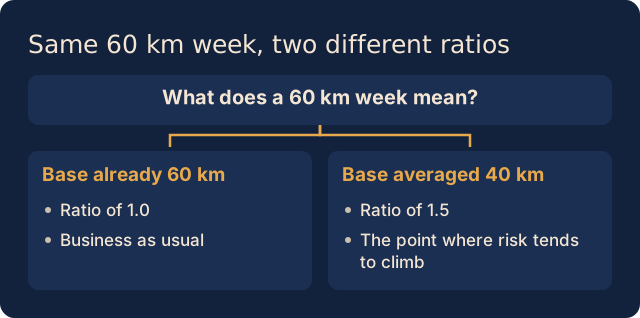
Big weeks alone are not the problem the ratio describes. A runner who has held 60 km a week for months carries that load differently from a runner who jumped to 60 km from 35. The ratio separates those two cases; a weekly total alone cannot.
How is the ACWR calculated?
The ACWR is acute load divided by chronic load. Acute load is your training in roughly the last 7 days. Chronic load is your rolling average over roughly the last 28 days, the base your body has been conditioned for. Load can be weekly distance, or something effort-weighted like duration × intensity.
Effort-weighted load is the better input, because 10 km of intervals isn't 10 km of jogging. A distance-only ratio misses a week where the kilometres stayed flat but two easy runs turned into hard sessions. Some calculations also weight recent days more heavily instead of using a plain average, which changes the number you see.
A worked example
Take a runner whose last four weeks averaged 40 km. A 40 km week gives a ratio of 1.0, business as usual. A 48 km week gives 1.2, inside the band most studies cite. A 60 km week gives 1.5, the point where risk tends to climb. The same 60 km week is a ratio of 1.0 for a runner whose base is already 60 km.
Distance is the easiest input to read, and also the bluntest. If the 48 km week included a long run far longer than usual, or a new block of hills, the effort-weighted ratio sits higher than 1.2. The distance number calls that week routine; the legs would disagree.
The rough sweet spot
The often-cited zone is about 0.8 to 1.3, with risk tending to climb above about 1.5. Below about 0.8 you're detraining or tapering, which is sometimes exactly what you want. The classic build of about 10% per week keeps you comfortably inside the band. Hold these numbers loosely: they are population averages from imperfect studies, not a personal speed limit, and the exact figures shift with how load is measured.
Why the ratio is a guide, not a rule
The ACWR has had real academic pushback, including a paper on the ACWR's conceptual issues and fundamental pitfalls. The results depend heavily on calculation method, and the danger zone isn't as crisp as early papers implied. In the common calculation, the acute week is also part of the 28-day average, so the two numbers are not independent of each other.
The ratio is also blind to everything off the road: sleep, work stress, nutrition, life. A 1.4 in a calm, well-slept week is a different animal from a 1.2 during a brutal work stretch on five hours' sleep. Read the ratio as one voice among several, a prompt to look closer and not a verdict to obey.
Where the number misleads
A low chronic load makes the ratio jumpy. After a break, an injury or a holiday, the 28-day average is small, so an ordinary run back produces a ratio that looks alarming. The return still deserves care, but the number overstates a modest restart and says little about which runs are sensible.
A taper pushes the ratio the other way. Load drops on purpose before a race, so a ratio well under 0.8 is the plan working, not detraining. The race itself then lands as one large spike in the acute week. The days after a race are a recovery question, which the ratio was never built to answer.
What should you check in your own data?
Your own data needs three answers before the ratio means much. Does your load measure include intensity, or only distance? Do you have at least four weeks of consistent records, so the chronic side reflects your real base? What did sleep, resting heart rate and how runs felt do in the same week as the spike?
A rising ratio is a question, not a command: did I ramp faster than usual on purpose, and does the rest of my life have room for it? Sometimes the honest answer is yes: a planned build, feeling good, carry on. Sometimes the honest answer is that you're fried and the week should hold steady. The number sharpens the question. You still answer it.
Sources
- The training-injury prevention paradox: should athletes be training smarter and harder?. Gabbett, 2016, Br J Sports Med.
- Acute:Chronic Workload Ratio: Conceptual Issues and Fundamental Pitfalls. Impellizzeri et al., 2020, Int J Sports Physiol Perform.
- How much is too much? (Part 1) International Olympic Committee consensus statement on load in sport and risk of injury. Soligard et al., 2016, Br J Sports Med.
What does my ratio actually mean?
- What is the acute:chronic workload ratio?
- The acute:chronic workload ratio is your training load from roughly the last 7 days divided by your rolling average over roughly the last 28 days. A ratio near 1.0 means this week matches your norm; well above 1.0 means you've spiked; below 1.0 means you've eased off.
- What is a safe acute:chronic workload ratio?
- Research points to a rough sweet spot of about 0.8 to 1.3, with injury risk tending to climb above about 1.5. Treat these as soft guides, not hard cutoffs: they are population averages, and the exact numbers vary by person and by how load is measured.
- Is the acute:chronic workload ratio reliable?
- The ratio is a useful flag, not a verdict. The ACWR has real methodological criticisms, depends heavily on how you measure load, and ignores sleep, stress and life factors. Use it as one early-warning signal among several, not as a number to obey.
Tempo tracks your load — and reads it with you
Tempo computes your acute:chronic balance from your synced runs and flags a spike in plain language, with the trade-off, then leaves the call to you.
Start free: 14 days, no card