Compare
You train from a goal. Keep the goal. Change what happens when the week goes wrong.
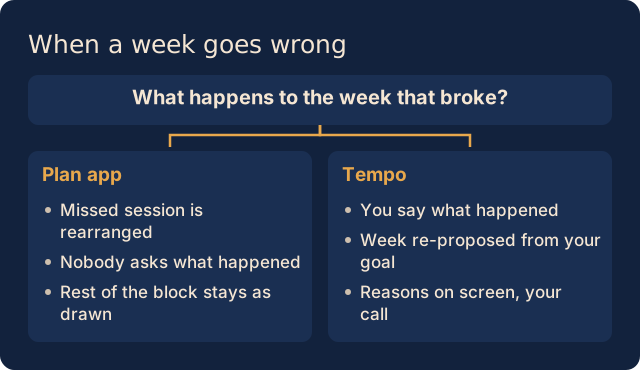
A plan app is an app that turns a race and a date into a full training block. Tempo starts from the same race and date. The difference shows the first week that goes wrong: the plan app rearranges the missed session, while Tempo asks what happened and re-proposes the week from your goal, reasons on screen, your call.
What does a plan app get right?
A plan app gets the starting point right: training from a goal is the right instinct. A block you can see is a real comfort. Tempo works from the goal too. Nothing on this page argues against having one.
The open question is what the goal is allowed to do once the weeks start happening.
Where does the block break?
A plan app's block breaks whenever a week stops matching the block as drawn.
The same plan for everyone who picked your goal
A reviewer of a plan app put the problem plainly: pick a goal and you get much the same plan as everyone else who picked it. The week you actually had never reaches the generator.
The reshuffle nobody explains
Runners who have used plan apps that promise to adjust describe the adjustment the same way: the missed session gets rearranged, and nothing explains why or asks what happened that week.
The week does not hold still
Across real training conversations the same pattern keeps showing up: eleven schedule disruptions from nine different runners in four months. Work, travel, illness, low motivation. Nobody runs the plan exactly as written, and a week that breaks is normal, not failure. A block drawn on day one is drawn for a life that does not exist yet.
The goal is a conversation, not a form
A runner's stretch goal got evaluated against an old personal best instead of last weekend's race, and the real gap turned out to be durability, not speed. Old PRs are outdated evidence for judging today's ambition. The goal deserves the same reasoning as the week: what does your current training say about it, and do you agree?
What should a training plan do when the week goes wrong?
A training plan should respond to how the training actually landed, not only to which session went missing. Training load is the work a runner did, and the same load does not produce the same result in every runner or in every week. Sports science treats this as a monitoring problem: track the load, track the response, and adjust what comes next.
The runner's own report is a large part of that response. A systematic review on monitoring how athletes respond to training found that subjective, self-reported measures beat the objective measures commonly used. How a session felt, how sleep went, what happened at work that week: the runner holds that evidence, and a block that never asks for it cannot use it.
A reshuffled block answers a narrower question. The missed session moves to another day, and the rest of the block stays as drawn, whether the week was missed for a cold, a work trip or a flat stretch of fatigue. Those weeks look the same in a calendar and call for different weeks after them.
What to check in your own week
The week that went wrong is worth naming before anything gets moved. A missed session from a busy work week, a missed session from illness and a missed session from fatigue that had been building are different events, and the week that follows each of them is different too.
The next key session is the honest check. Pace and effort lining up the way they did before the disruption means the week held. A familiar session that feels clearly harder is information about the week before, and a plan that only counts sessions does not see it.
Tempo, once
When life gets in the way, you tell Tempo what happened and it re-proposes the week from your race goal, with the reasons on screen, and you can push back before anything changes.
In practice: you say the week got wrecked and why. The re-proposal names the race goal and the load lines it reasoned from, and you can disagree with it line by line. You push back on one session, and the proposal changes; a decision you make in that conversation stays made. Last month's niggle and last week's decision reach today's proposal without you repeating them. Tempo stays a sparringpartner, not a coach, and never becomes one. The decision stays yours.
Who this is for
You belong here if
- You've read at least one running book (and highlighted passages)
- You have opinions about training philosophy you'd defend at dinner
- You question whether your easy runs are truly easy
- You adjust your plan based on how you feel, then lie awake wondering if you should have
- You've considered a coach but don't want to give up control
- You'd rather understand WHY than be told WHAT
You're not looking for
- Someone to tell you what to do
- Motivation to get out the door
- A plan to comply with
- Someone to take over
Sources
- Monitoring Athlete Training Loads: Consensus Statement. Bourdon et al., 2017, Int J Sports Physiol Perform.
- Monitoring the athlete training response: subjective self-reported measures trump commonly used objective measures: a systematic review. Saw et al., 2016, Br J Sports Med.
- Variable dose-response relationship between exercise training and performance. Busso, 2003, Med Sci Sports Exerc.
Questions runners ask
Does Tempo work from a race goal like a plan app?
Yes. You give Tempo the race and the date, and every week is proposed from that goal. The difference is what happens next: the week is a proposal with its reasons on screen, not a block to comply with, and the goal itself is judged against your current evidence, not an old personal best.
What happens in Tempo when I miss a week?
You tell Tempo what happened. Tempo re-proposes the week from your race goal, shows the reasons it used, and you can push back before anything changes. Nothing is rearranged silently.
Does Tempo give me a full training plan on day one?
No. Tempo proposes the coming week from your goal and your recent training, with the reasons on screen, and the block builds week by week from what actually happened. A block drawn in full on day one is drawn for weeks that have not happened yet.
Is Tempo better than a plan app when life gets in the way?
When life gets in the way, you tell Tempo what happened and it re-proposes the week from your race goal, with the reasons on screen, and you can push back before anything changes. A plan app rearranges the missed session and does not ask what happened.
Does Tempo change my plan without asking?
No. Tempo proposes, shows why, and waits. A decision you made in a conversation stays made, and last week's decision reaches today's proposal.
Does Tempo write my plan for me?
No. Tempo proposes and shows why. The runner decides, and a decision made in a conversation stays made. Tempo stays a sparringpartner, not a coach, and never becomes one.
Keep the goal. Change what happens when the week goes wrong. 14 days free, no card. €19 a month or €190 a year after that.
Start with Tempo