What should the last week before a half marathon look like?
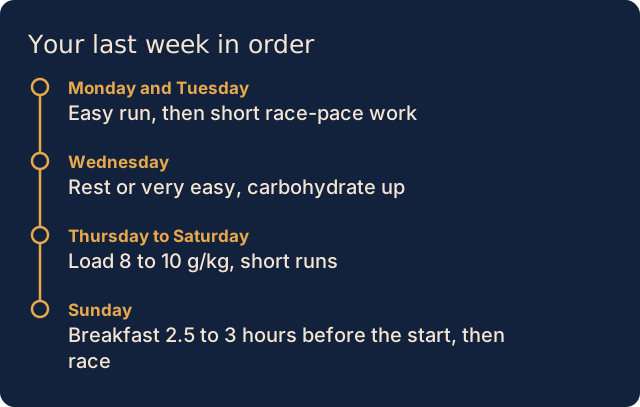
The last week before a half marathon comes down to three things: cutting training volume to 30 to 50% of a normal week, filling your glycogen stores over three days with 8 to 10 grams of carbohydrate per kilo per day, and sorting race day in advance. Seven days build no new fitness.
Three things not to miss
- Eat 100 to 150 grams of carbohydrate 2.5 to 3 hours before the start, and stop drinking 45 minutes before it.
- Making up missed sessions is the biggest mistake: all it does is put you on the start line more tired.
- At a beach race like Egmond you run on feel and heart rate, because wind and sand make your splits unreliable.
What should the last week look like, day by day?
Below is a plan for a half marathon on Sunday, for someone who normally trains 3 to 6 times a week. If you normally run three times a week, keep Tuesday, Thursday and Saturday.
| Day | Run | Food | To do |
|---|---|---|---|
| Monday | Easy run, 40-50 min | Normal, about 5 g/kg carbohydrate | Check your race entry and the route |
| Tuesday | 30-40 min with 3 x 3 min at race pace | Normal | Lay out shoes and kit |
| Wednesday | Rest or 30 min very easy | Carbohydrate up to about 7 g/kg | Buy gels and drinks, nothing new |
| Thursday | 30-40 min with 3 x 1 min at tempo | Loading starts: 8-10 g/kg | Plan your sleep, check travel time |
| Friday | Rest | 8-10 g/kg, low fibre | Race kit, safety pins, weather |
| Saturday | 20 min jog + 4 strides | 8-10 g/kg; simple, carbohydrate-rich dinner | Pack your bag: gels, dry shoes, warm layer |
| Race day | 10-15 min warm-up + strides | Breakfast 2.5-3 hours before the start: about 2 g/kg | Arrive early, toilet, warm-up |
Why each day is built this way
You fill glycogen over several days. The ISSN position stand on nutrient timing names 8 to 12 g/kg per day as the diet that fills your stores most, and describes 8 to 10 g/kg for one to three days working when you cut training at the same time (Kerksick et al., 2017).
The short tempo blocks keep your legs fresh; several rest days in a row leave many runners heavy and slow. Building this yourself? Read whether you need a full marathon training plan.
How much should you still run without losing fitness?
You built your fitness over months; seven days add nothing. So your volume drops to roughly 30 to 50% of a normal training week. A meta-analysis of taper studies landed on two weeks of cutting back, with 41 to 60% less volume while intensity and the number of sessions stay the same (Bosquet et al., 2007). Your last week is the deepest part of that cut; for the rest, read how long a taper needs to be.
What you stop doing: long runs, hard interval sessions and new strength work.
Watch your resting heart rate this week: a steadily rising value points to incomplete recovery and is no reason to train harder. More in what a rising resting heart rate means. Tempo reads your activity history and talks through whether this taper suits your legs, also when you write your own plan.
What should you eat in the days and hours before the start?
Carbohydrate: when and how much
Glycogen is your limiting factor, and you fill it over the last three days with 8 to 10 grams of carbohydrate per kilo of body weight per day. For a 70 kilo runner that is 560 to 700 grams. In practice: rice, pasta, bread, potatoes and bananas at every meal, plus a snack such as dried fruit or gingerbread. Eat a little less fat and protein so you don't feel stuffed.
The evening before, eat something familiar. If the last week leaves you tired and restless, read why the taper feels so hard.
Breakfast and gels on race day
Eat a light breakfast of about 2 grams of carbohydrate per kilo 2.5 to 3 hours before the start, for most runners 100 to 150 grams: white bread with honey and a banana works. From 45 minutes into the race, take a gel every 20 to 25 minutes with a few sips of water. The ISSN names 30 to 60 grams of carbohydrate per hour; check the packet to see how much your gel holds.
How does preparing for a beach race like Egmond differ?
The Egmond Halve Marathon falls on the second Sunday of January, in 2027 on 10 January. You start on Boulevard Noord in Egmond aan Zee and run the first seven kilometres on the sand. At Castricum you head into the dunes, and the steep Bloedweg brings you back to the finish on the boulevard. Your breakfast moves with it: the provisional programme puts the half marathon start at 12.16.
Wind, sand and tide: what they do to your pace
Don't count on your normal race pace. On soft sand, running cost 1.6 times as much energy as on a hard surface in one study (Lejeune et al., 1998). How much you pay varies by year: the organiser names the weather and the shifting tides as what makes every edition different. Firm sand runs easier, so check the tide table and wind forecast in race week.
A headwind on those seven kilometres doesn't come back to you: the beach is no out-and-back, and after it you disappear into the dunes. So run on feel and heart rate instead of pace, especially in the first kilometres.
Rehearse this: do a short tempo block on sand or unpaved ground, in the wind. If that means moving a session, build the week around it as with a training week that survives a work trip.
Clothing and kit for the beach
Frost at the start and overheating after ten kilometres can sit in the same race. Choose thin long tights or thermal leggings, an old shirt to take off around the start, and a hat and gloves you can stow on the way. Skip shoes with deep lugs: on firm sand a normal road shoe is fine.
What do beginners get wrong most in race week?
The biggest mistake is "making up for it": chasing a missed long run or adding kilometres because you feel good. That fitness is already built. Run too long on Wednesday and you feel it on Sunday.
Then come the classics: new shoes that blister after 15 kilometres, carb-loading only on Saturday when your stomach is already full, and spending all of Saturday on your feet at an expo. More in our background on tapering and race week.
What belongs in your race morning routine and checklist?
Timeline from breakfast
Eat 2.5 to 3 hours before the start and leave in good time. In 2026 Egmond aan Zee was closed to cars from 8.00 to 18.00 on race day, and shuttle buses from Alkmaar and Heiloo ran to the village until 12.00; check the arrangements for 2027. Count the walk too: the bag drop at Sporthal De Watertoren is about a kilometre from the start. Take small sips until 45 minutes before the start.
Checklist for your bag
- Race number, already fixed with pins or magnetic clips
- Old sweater or bin bag to stay warm until the start
- GPS watch charged, with the race set up as an activity
- Gels and drinks you already tested in training
- Tape for your nipples and against blisters
- Dry clothes and a warm drink for after the finish
What does a bad night's sleep before the race cost you?
One bad night costs you something, but your race doesn't hang on it. In a meta-analysis, sleep loss had a moderate negative effect on endurance performance, stronger in efforts over 30 minutes (Lopes et al., 2023). So sleep well in the days before: that part you can arrange.
Sources
- Effects of tapering on performance: a meta-analysis. Bosquet et al., 2007, Med Sci Sports Exerc.
- International society of sports nutrition position stand: nutrient timing. Kerksick et al., 2017, J Int Soc Sports Nutr.
- Mechanics and energetics of human locomotion on sand. Lejeune et al., 1998, J Exp Biol.
- How much does sleep deprivation impair endurance performance? A systematic review and meta-analysis. Lopes et al., 2023, Eur J Sport Sci.
Still unsure about your race week?
- How much water should I drink in the days before a half marathon?
- Drink to thirst and keep your urine pale yellow. On race day take small sips until 45 minutes before the start, then nothing more to avoid a full bladder. Do take a drink with your gels, also at a cold beach race like Egmond.
- Should I still do strength or core training in race week?
- No, leave strength and core work out of the last week. They add no fitness and do bring muscle damage and fatigue you feel on race day. Your legs need to be fresh, not stronger.
- How fast should I run the first kilometres so I don't start too hard?
- Run the first kilometres on feel and heart rate instead of pace, especially at a beach race. The first two kilometres should feel easier than race pace. Adrenaline masks effort, so watch your breathing: you should still manage short sentences.
- What can I do about nerves before the race?
- Nerves are fuel: your body is waking you up and sharpening you. What makes them worse is worrying. So practise a fixed routine in your training weeks: same breakfast, same arrival time, same warm-up. If you do lie awake, don't stare at the clock: breathe slowly in a 4-7-8 rhythm or read a book.
Tempo lays your taper next to your own training
Your training load, resting heart rate and the runs of recent weeks come together, so you decide how to fill this week.
Start free: 14 days, no card