Did I peak too early? Taper flatness vs real fatigue
Peaking is the point where training fatigue has cleared and the fitness built in a block shows up as race performance. Feeling flat in the taper almost always means the taper is working, not that the peak came early. Genuine early peaking is rare and starts before the taper: a sustained performance drop, raised resting heart rate, broken sleep.
Why does the taper feel so awful?
The taper feels awful because cutting training load lets the body clear accumulated fatigue and run repairs the body had postponed. The process feels strange: heavy legs, random phantom aches, low energy, the conviction that you've forgotten how to run. None of the heavy legs or phantom aches is fitness leaving. Fitness was built in the hard weeks before, and fitness doesn't evaporate in ten days. The taper doesn't create fitness; it reveals the fitness that fatigue was hiding.
What does peaking too early actually look like?
Peaking too early looks like a decline that started while you were still training hard, not one that started with the taper. The signals worth taking seriously predate the taper: a genuine drop in performance for a week or two of full training, a resting heart rate that has stayed elevated, broken sleep, appetite and mood that are off, and a flatness that comes with real apathy rather than freshness plus nerves.
One odd day proves nothing. A fortnight of warning signs stacked together is the pattern that matters. Ordinary taper flatness lifts on race morning and deep over-fatigue doesn't, which is why telling the two apart is worth doing before the race rather than during it.
Nerves or fatigue: the strides test
Pre-race anxiety mimics fatigue almost perfectly: the doubt, the heavy legs, the "I've lost it" feeling. A useful tell is a few strides or a short burst at race pace. Legs that snap back and feel quick once you ask for pace point to a runner who is fresh and nervous, not over-cooked. Legs that stay leaden even when you try to turn the legs over are a stronger fatigue signal worth weighing.
Where the strides test falls short
The strides test separates nerves from fatigue, but flatness has other causes. Carbohydrate loading in the final days stores glycogen along with water, and the extra weight can make legs feel heavy on a short run. A cold coming on can feel like flatness for a day or two before any other symptom shows. Heat, travel and a disrupted sleep schedule in race week add their own layer.
Undertraining is the other edge case. A block cut short by illness or injury can leave a runner flat because the fitness was never fully built, not because fatigue is hiding it. In that case the taper has less to reveal, and freshness doesn't raise the ceiling. The question there is goal pace, not the taper.
What should you check in your own training data?
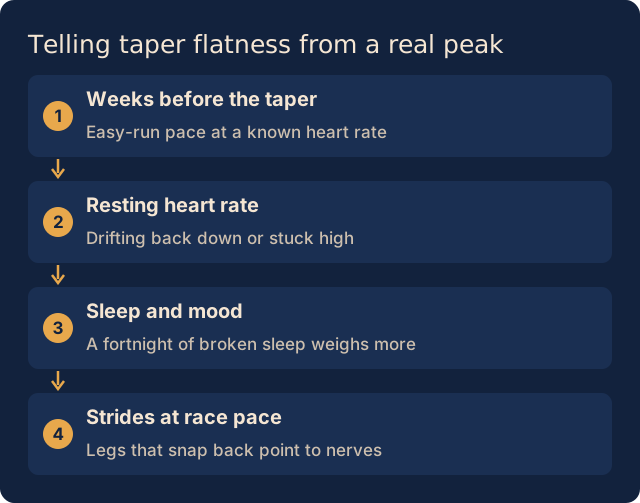
Your training data answers the question in the order the warning signs appear. Start with the weeks before the taper: pace at a known heart rate on easy runs, and how your key sessions came in. Steady or improving numbers through the peak say the fitness was there when the load came down.
Resting heart rate is the second check. A value that drifts back toward your normal range as the taper goes on fits fatigue clearing. A value that stayed raised through the last hard weeks and keeps sitting high into the taper fits the over-fatigue pattern above. Sleep and mood sit alongside it, and a fortnight of broken sleep and low drive in the peak weighs more than any single number.
Single readings have limits. A resting heart rate taken after a poor night, in a hot room or after alcohol can sit high for reasons unrelated to training, so the trend across several mornings carries the signal and one morning is noise. Pace at a known heart rate also shifts with heat and terrain, which makes the same route in similar conditions the fair comparison.
Two patterns can sit under the same flat feeling ten days out. In the first, session paces held steady through the peak, resting heart rate is drifting down, and the legs wake up on strides: that is a taper doing its job. In the second, session paces slipped for a couple of weeks before the taper, resting heart rate is stuck high, and strides stay heavy: that is the early-peak pattern. Same feeling, different data.
Why a confidence session backfires
A "confidence" hard session in the final week rarely helps. There isn't time to absorb new fitness, so the session mostly adds fatigue right when you're trying to shed it. Short strides or a handful of race-pace minutes can wake the legs up without that cost.
The motive is worth an honest look. Reaching for a hard session to feel reassured, rather than because you're genuinely under-trained, trades race-day freshness for a few minutes of calm. The call is yours; make it with clear eyes.
Sources
- Variable dose-response relationship between exercise training and performance. Busso, 2003, Med Sci Sports Exerc.
- Effects of tapering on performance: a meta-analysis. Bosquet et al., 2007, Med Sci Sports Exerc.
- Prevention, diagnosis, and treatment of the overtraining syndrome: joint consensus statement of the European College of Sport Science and the American College of Sports Medicine. Meeusen et al., 2013, Med Sci Sports Exerc.
- Monitoring Athletic Training Status Through Autonomic Heart Rate Regulation: A Systematic Review and Meta-Analysis. Bellenger et al., 2016, Sports Med.
Flat before race day? What runners ask
- Why do I feel flat during my taper?
- Taper flatness is common and in most cases not lost fitness: your body is shedding fatigue and repairing. The taper reveals fitness; it doesn't create it.
- How do I know if I peaked too early?
- Look for a sustained performance drop before the taper, elevated resting heart rate, poor sleep, and flatness with real apathy. Normal taper flatness lifts on race day.
- Should I add a hard session if I feel flat?
- Usually no, because a hard session adds fatigue you can't absorb in time. Strides or a few race-pace minutes can sharpen the legs without the cost.
Tempo can tell taper-flat from genuinely cooked
Tempo sees your load coming down, your resting heart rate and your sleep, and helps you read whether it's freshness, nerves or real fatigue. You decide what to do with it.
Start free: 14 days, no card